When you buy a weather station for a Kenyan farm, it normally comes as a bundle: rain, wind, air temperature, humidity, pressure and sunlight. The Kenya Meteorological Department's own description of a typical station lists the same set, though pyranometers (sunlight sensors) are added only sometimes. A grower should ask a narrower question. Which of these readings will change something you do on Monday? A sensor with no decision attached is a cost with a battery in it.
We go through the six, one decision each, and take a position on every one. This deals in measurements only. A station records what happened. It does not tell you what is coming, and nothing here should be read as a forecast.
Measured by NuaSense weather stations and soil probes on Kenyan farms, over the period stated with each figure. Past readings, not a forecast.
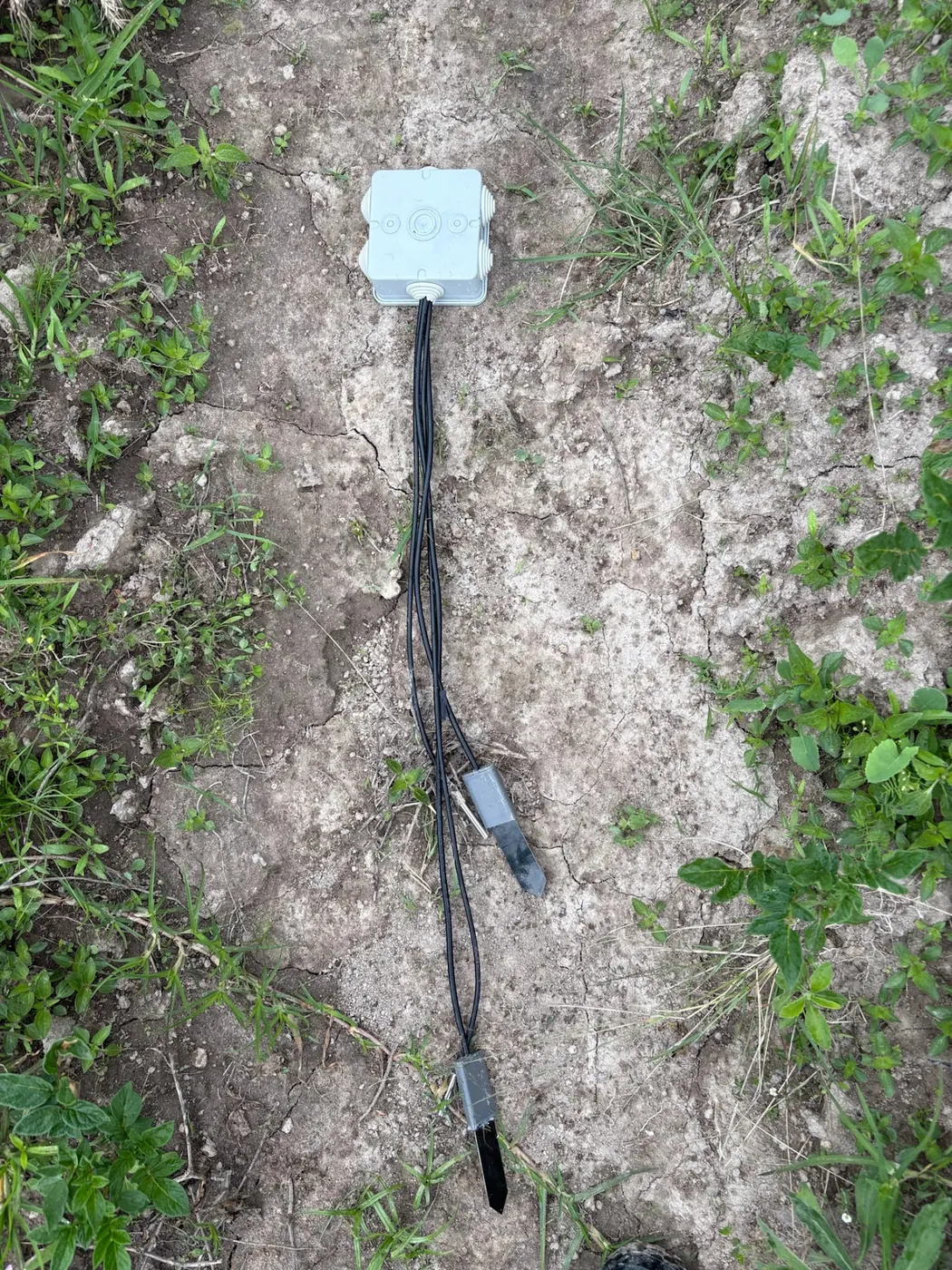
The rain gauge: re-sowing and nothing fancier
Start with the sensor most farms should own. In Busia County in March 2019, PlantVillage reported that many farmers planted maize at the start of the long rains, saw no germination and had to re-sow. In some cases the second sowing failed too. The decision a gauge serves is exactly that one: did enough rain fall on this field to justify the seed, or did a shower that wet the road leave the seedbed dry?
A rain gauge answers it with a number from your own ground. That matters because rain is the most local of the variables. At four NuaSense stations from 11 September to 11 October 2026, station totals ranged from 0.4 mm to 76.4 mm. Those stations are not co-located and the spread is not a regional figure, but it shows how far two gauges can disagree within one month.
Our own stations count tips of a tipping bucket and convert them to millimetres using the per-tip volume the gauge is calibrated to. Many automatic stations do the same. A manual gauge does the same job by hand. The University of Florida's guidance on farm weather stations says that if rainfall is the only interest, a good quality manual gauge of the kind used by the CoCoRaHS volunteer network is adequate. I agree. If you will not read a phone dashboard, buy the manual gauge and write the number in a book each morning.
One more fact about rain makes the point. Of 10,982 ten-minute readings in that month, only 185 recorded any rain at all, which is 1.7 percent. Rain is rare in the record and large when it comes, so the gauge spends most of its life idle and still earns its place on the day that matters.
Air temperature: the cold-night decision
Air temperature is the second sensor worth owning, and the decision it serves is cold protection. The Florida guidance states that cold protection needs air temperature plus relative humidity and wet bulb temperature. So the thermometer on its own does not finish the job, but it is the part you cannot do without.
Look at the spread. Across seven NuaSense stations over 11 September to 11 October 2026, air temperature ran from 6.0 to 36.7 °C with a mean of 19.8 °C. A mean of nearly 20 hides a 30-degree swing, and your crop lives in the swing, not the mean. The lowest readings come at the end of the night, which is when the decision is made, so the sensor has to log through the dark and not just be read at noon.
Accuracy deserves a line. Florida guidance puts a medium-cost station's temperature sensor at ±1°F across its range. That figure is in Fahrenheit, so at best it is about half a degree Celsius. Do not set a frost margin right against that edge. We publish no tolerance figure for our own sensors, and we will not attach one here.
How you mount it matters as much as the sensor. That same guidance calls for temperature sensors to be shielded and ventilated, sitting over short grass in an open area at least 10 m across. Put a bare probe in the sun and it reads the sun, not the air. The FAO annex on weather data integrity notes that shields are naturally ventilated and sometimes artificially aspirated to cut bias from solar heating. Before you pay for the sensor, check the shield.
Wind: when to spray and when to hold the sprayer
On a farm that sprays, wind is the sensor that earns its keep most directly. The Arizona growers' guide to weather stations says wind speed and direction are critical when choosing the best times for sprinkler irrigation and chemical spraying, to keep application efficient and drift losses low. It also says wind is more unpredictable and more locally variable than the other parameters. That second point is why you should measure it yourself.
Our spray window quality score is an hourly index from 0 to 100, worked out from the station's own readings. It shows how seldom conditions line up. Across 5,000 station-hours from seven stations, over 11 September to 11 October 2026, only 18 percent scored 60 or better. Another 56 percent scored below 30. Spray on a fixed morning routine and most of those hours would have been poor ones. That describes the record, not next week.
Know what the numbers mean. Wind speed comes from a rotating anemometer. Its pulses are counted and converted. A gust figure is the peak inside the reporting interval, not an instantaneous reading. One high gust does not mean the whole ten minutes was gusty.
Wind readings usually go wrong at the mounting stage. The FAO annex puts anemometers at not less than 2 m, and often 5 m, following WMO recommendations. It says accuracy depends on upwind fetch as much as on the instrument. The Florida text gives 2 m for agro-meteorological use, and notes NOAA recommends 10 m. The sources don't agree, so pick a height, write it down, and stick to it. Our wind data page shows what the readings look like.
Humidity and leaf wetness: where a medium-cost sensor is weakest
People buy humidity sensors for disease. The trap is accuracy. Florida guidance gives a typical medium-cost relative humidity sensor as ±3% below 90% RH and ±4% to 5% above 90% RH. It adds that this drop above 90% is a problem when the reading is used to estimate leaf wetness duration in a disease model.
Put that next to a Kenyan night. Across our seven stations, relative humidity averaged 69% over 11 September to 11 October 2026. It ranged from 18% to 100%. The humid hours that drive disease sit at the top of that range. That is exactly where the sensor is least certain. So if you are buying to time disease, humidity alone is a weak basis.
Some plant-disease risk models need a dedicated leaf wetness sensor, the same guidance says. Put it 30 cm up, tilted 45 degrees, facing north in the northern hemisphere, over short grass and away from sprinklers. Watch out: that facing rule is written for the northern hemisphere. A Kenyan site straddles the equator, so check the orientation guidance for your latitude before you mount one.
At our station, leaf wetness duration is a derived value, not its own sensor. Over seven stations in the same month, 25% of station-hours came back leaf-wet, about 6.0 hours in an average day. The FAO annex notes dew point instruments need careful upkeep and are seldom found on stations. So take dew point as a computed figure, and don't buy a dedicated instrument.
Sunlight: the sensor with a hidden limit
A sunlight sensor, the pyranometer, matters for one decision: irrigation scheduling through reference evapotranspiration. The Florida guidance says that calculation needs solar radiation, wind speed, relative humidity and air temperature together. If you don't schedule irrigation from ET0, you don't need the sensor.
For those who do, here's the catch with the cheap option. The FAO annex says silicon diode pyranometers are the less expensive type gaining acceptance, but they aren't fully sensitive across the visible spectrum. Their calibration is valid only for upward solar measurement. Downward-facing albedometers, which measure reflected light, have to be glass-dome thermopile types, because light reflected from vegetation is heavily biased toward green. So the affordable sensor is fine for incoming sun and wrong for anything else.
Net radiation is another matter. The same annex says net radiometers have black bodies that lose sensing capability over time and need regular, frequent calibration. That's a running chore, not a one-off purchase.
Siting here is simple. The Florida guidance puts a solar sensor on the southernmost side of a station in the northern hemisphere so it doesn't sit in shadow. That rule is written for the northern hemisphere again, so for a site near the equator, the safe reading is: put it where the mast and nearby objects cast no shadow on it at any hour. The sunshine-hours heliograph, a burn trace on paper, is the old method and not what a farm needs.
Our own figures show why this chain is worth it for those who irrigate. Reference ET0 computed hourly with FAO-56 averaged 1.6 mm per day across seven stations over 11 September to 11 October 2026. That's reference ET0, not crop water use.
Pressure: the sensor to leave off
Pressure is the sensor I'd cut first. A barometer appears in the Kenya Meteorological Department's typical station list and in the Arizona and Florida basic categories, so it's standard. Standard is not the same as useful. None of the sources tie a farm decision to a pressure reading.
Pressure still tells you something. Meteorologists use it. But using pressure to say what weather is coming is forecasting. A farm sensor with no model cannot do that, and we do not do it. Research is a different matter. A proposed IoT mini weather station for Kenyan small-scale farmers carries humidity, temperature, light and pressure. It sends data to a cloud server as input to machine learning advice. That is a design for a system, not evidence that a grower acts on a pressure number.
The Meru University of Science and Technology got a station from the Kenya Meteorological Department. It has four sensors: rain, air temperature, humidity and atmospheric pressure. The station is 3D-printed in Kenya, so its sensors are easy to replace. That shows pressure belongs in a network station, where a meteorological service uses it. It does not show a farm needs it.
If the station you buy has pressure, fine. Reading it costs you nothing extra. If you are picking sensors one at a time, skip pressure and spend the money on a better site or a second rain gauge.
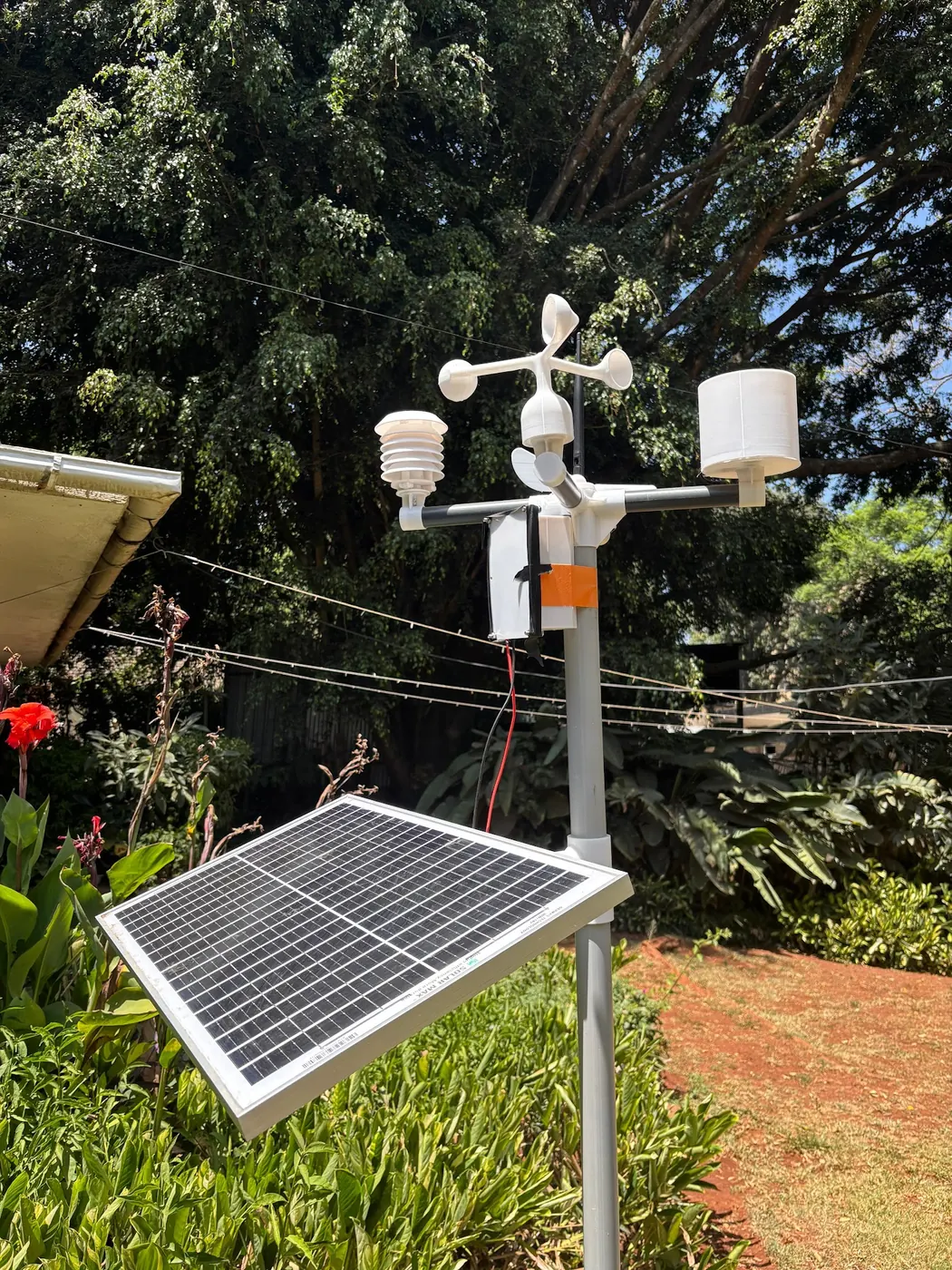
Where you put it decides what it is worth
Put a good sensor in a bad spot and you get a confident wrong number. The Florida guidance says place a rain gauge as far from obstructions as you can. Ideally, it should sit at four times the height of the nearest obstruction, with a level collector open to the sky. Temperature and humidity sensors need at least 4 times the obstruction height, or 30 m from large paved areas. The Arizona guide gives about 10 times obstacle height for stations in general. Those are foreign rules. No Kenyan table replaces them. So work them out for your own trees and buildings.
Here is a worked case. A 6 m tree means 24 m clear for the gauge under the 4-times rule, and 60 m under the 10-times rule. Many farm yards cannot offer that. That is the argument for a cheaper station on a clear plot over a dearer one beside the packhouse. Our siting post, weather station siting and how much clear ground each sensor needs, works through these rules sensor by sensor.
Then comes upkeep. The Florida guidance says the most common gauge fault is a clogged funnel from insects, grass clippings and dirt, and it should be checked weekly. It also says cleaning up data may cost more than keeping the station in good order. And the only thing worse than no data is wrong data. FAO says much the same: no data are better than bad data, because biased local data can drive irrigation decisions that do more harm than textbook values. A weekly funnel check is the cheapest part of the whole system.
Do you need your own station at all?
Sometimes no. The Arizona guide, citing the World Meteorological Organization, describes weather data as most reliable within 60 miles for large-scale patterns. For local uses such as precision farming, it is most reliable within 6 miles. Kenyan SMS advice works at another scale. PlantVillage's service uses CHIRPS rainfall data at 5 km resolution and sends forecast messages within a radius of 5 to 9 km.
Its survey is worth reading honestly. Of 4,272 Kenyan farmers, 3,577 said the SMS helped them. Of those, 51% said it helped them plant on time. That speaks to the value of the messages to farmers. It does not verify measurement. Still, if your decision is when to plant and your farm is small, a free message may do.
Distance has a cost, and the Arizona guide shows it. At Gila Bend, Arizona, one grower's humidity was compared from 12 to 19 February 2025 with stations 15, 27 and 41 miles away. Those differences could affect local ET0-based irrigation decisions. So the farther the nearest station, the less it says about your block. For rainfall, the earlier piece in this series, why the nearest weather station does not describe your farm, covers that spread directly.
Each dekad, the Climate Hazards Center mixes more than 90 additional stations from Ethiopia, Kenya and Somalia into CHIRPS. That makes the free grid better, but it does not put a gauge on your field. If you farm one small plot, have no irrigation scheduling and can read an SMS, buying nothing is a defensible call.
What the options cost and what each buys
Here are the choices side by side. Prices are only given where we publish them, and no retail prices for other makers are stated.
- Manual rain gauge, read daily by hand: adequate if rainfall is your only interest, per the Florida guidance. Buys the re-sowing decision. No power, no data link.
- Free SMS or satellite rainfall: no hardware. Resolution is 5 km grid cells, so it cannot see the shower that missed your field.
- A reduced station (rain, air temperature, humidity, pressure), like the Kenya Meteorological Department unit at Meru: buys cold-night logging and humidity.
- A full station with wind and sunlight: buys spray timing and ET0 scheduling. Worth it only if you spray or irrigate by schedule.
Our own equipment sits at the top of that list. A NuaSense weather station costs KES 30,000 excluding taxes. Roughly every 10 minutes, it reports air temperature, humidity, pressure, sunlight, rainfall in millimetres, wind speed, gusts and direction. From those readings, it works out ET0, dew point, vapour pressure deficit, leaf wetness and the spray window score. It reaches the internet over a Safaricom SIM or Wi-Fi, runs on solar power and needs no mains. A soil sensor is KES 7,000, and its readings reach the internet through the station. The dashboard is free.
Which grower should not buy one? A grower with one small plot, no sprayer and no irrigation schedule. A manual gauge and a free SMS service cover that farm. Our pricing post on what a weather station costs in Kenya lays out the tiers. The NuaSense overview of IoT in Kenyan agriculture covers which low-cost sensors smallholders can realistically afford.
A decision rule you can use at the counter
Cut it to the decision each sensor serves. Rain gauge: re-sow or hold. Air temperature: protect against cold. Wind: spray now or wait. Sunlight, wind, humidity and temperature together: scheduling irrigation through ET0. Leaf wetness: disease timing. Pressure: nothing a farm acts on, so drop it.
Here is the test. Name the Monday decision. If you cannot, do not buy the sensor. Florida guidance says the application decides the sensor, and that is the whole principle. No source claims every grower needs all six, and I will not claim it either.
Two cautions on the other side. Fit the sensor to your own scale of decision, because distance matters more than brand. Before you budget for extra sensors, budget for a weekly funnel check and a clear site. A cheap station on open ground, cleaned weekly, beats a full one under a mango tree. The Kenya Meteorological Department traces weather observation back to the 1890s, when settlers and the Kenya-Uganda railway measured rainfall. Its first standard station started in 1926. Rain first, then everything else: that is the order Kenya has always measured in. It is still a sound order to buy in.