Start with the honest baseline, and the honest price. A rain gauge read by eye, once a day, at the same hour, costs almost nothing in Kenya and tells you almost everything you need if rainfall total is your only question. The University of Florida/IFAS guide on farm weather stations says exactly this: if the only interest is tracking rainfall, a good quality manual gauge, of the kind used by the Community Collaborative Rain, Hail and Snow project (CoCoRaHS), is adequate. CoCoRaHS trains volunteers to read the gauge and submit the number online. No power, no calibration schedule, no subscription. The catch is that a manual gauge tells you nothing about temperature, humidity, wind or how fast the rain actually fell. And it tells you nothing at all unless someone reads it every single day, including the Sunday nobody wants to walk out to the fence line.
The nearest free number you can get, and what it costs you
Before spending anything, ask what a farm already gets from public and shared instruments. The Kenya Meteorological Department FAQs list the fee for visiting one of their stations on an educational tour: Ksh30 per learner for primary and Junior High, Ksh50 for secondary, college and university, paid at the station office before the tour starts. That is not a data product. It is a tour fee, and the only hard shilling figure Kenya Met publishes about its stations at all. The department has also had to manage seven separate automatic weather station networks nationally, according to reporting from Columbia's International Research Institute for Climate and Society. Each was built by a different company, often with proprietary data formats that will not talk to one another. That fragmentation is a national problem, not a farm one. But it is a warning: buying into someone else's network, or expecting a nearby official station to stand in for your own field, carries the same interoperability and distance problems at a smaller scale.
The Arizona extension guide on selecting weather stations puts a number on how far you can trust someone else's gauge. Citing the World Meteorological Organization, the Arizona grower's guide on selecting and using weather stations states that weather data is reliable within 60 miles for large-scale patterns but only within 6 miles for local, precision-farming use. A field trial in Gila Bend, Arizona compared humidity readings against the three nearest official stations at 15, 27 and 41 miles away over one week in February 2025. All three distances sit outside the 6-mile precision radius. On a Kenyan farm, that means the nearest Kenya Met station, or a neighbour's station a few kilometres off, is probably giving you regional weather, not your field's weather. That matters once you are trying to time a spray or an irrigation set, rather than just track a season's rainfall.
What separates a basic station from a rain gauge
The next tier up is what the Arizona guide calls a Basic station: wind speed, air temperature, humidity, air pressure, rainfall and sunlight, measured with anemometers, thermistors, hygrometers, barometers, rain gauges and pyranometers. This is the tier where a station stops being a single-purpose instrument and starts being a weather record. The jump in usefulness is real. So is the jump in what can go wrong: a Basic station has moving parts (cups, wind vanes, tipping buckets) and needs power, however modest, to log and eventually transmit its readings.
The Florida guide is blunt about accuracy at this tier. A medium-cost humidity sensor typically holds plus or minus 3 percent accuracy below 90 percent relative humidity but degrades to plus or minus 4 to 5 percent above it. And that degraded range is exactly where leaf wetness duration models, used to flag disease risk, do their work. Air temperature on the same tier of sensor runs about plus or minus 1 degree Fahrenheit across its range. None of this is published as a spec for any specific product here. It is what the Florida guide reports for medium-cost sensors generally, and a reasonable expectation to carry into a Kenyan purchase decision rather than a promise any particular station will meet it. The practical lesson: a Basic station gives you weather. But if disease timing is the actual decision, ask what the humidity sensor does at the high end, because that is where the model needs it most.
The step that buys irrigation scheduling
Rainfall and temperature alone will not tell you how much water a crop actually needs. The Florida guide is specific about this: estimating reference evapotranspiration, the standard input for irrigation scheduling, needs a larger set of variables than a rain-only setup provides. Solar radiation, wind speed, relative humidity and air temperature, all measured together. This is also the basis of the FAO-56 method, described in the Arizona guide as the widely adopted way to calculate daily crop water requirements from local weather data. A station that only counts rain cannot feed that calculation. A station with the full sensor set can.
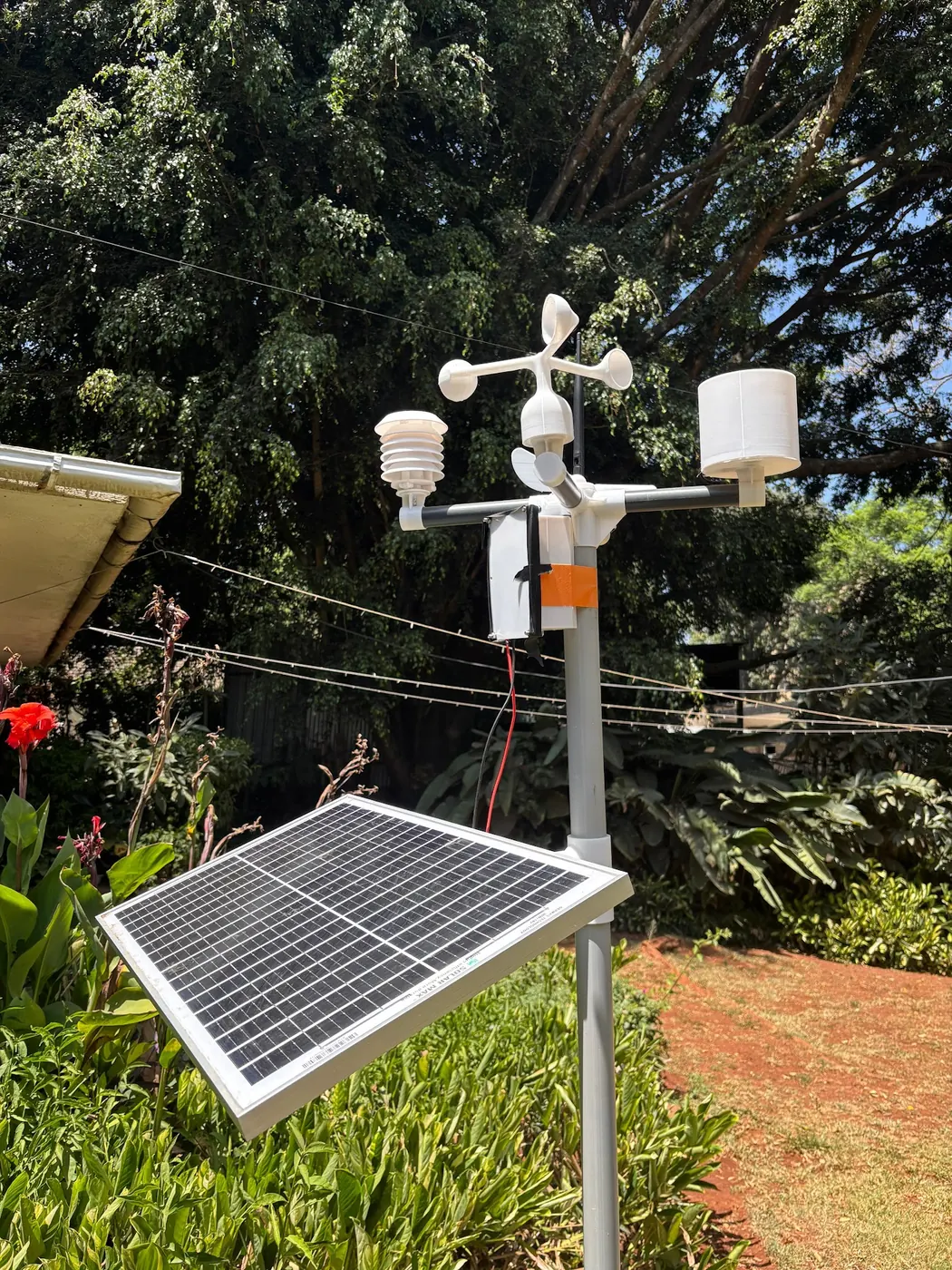
This is the tier where NuaSense sits. A NuaSense weather station costs KES 30,000 excluding taxes. It measures air temperature, humidity, air pressure, sunlight, rainfall, wind speed, gusts and direction roughly every 10 minutes, and from those readings computes hourly reference evapotranspiration by FAO-56, dew point, vapour pressure deficit, leaf wetness duration and a spray window quality score, all as derived values rather than extra sensors. Across our own network over 23 August to 20 September 2026, ET0 averaged 1.3 mm per day. Only 17 percent of station-hours scored 60 or better on the spray quality index, while 54 percent scored below 30. That is the kind of number a farmer only sees once the full sensor set is in place, not from a rain gauge or a Basic station. A grower whose only real question is rainfall total does not need this tier; someone timing irrigation sets or spray windows does.
Where soil measurement fits into the same bill
A weather station measures the air. It says nothing about what is happening at root depth unless it is paired with a soil probe reporting into the same system. NuaSense soil sensors connect over LoRaWAN through the weather station itself. The station on the mast both measures the weather and carries the soil sensor's readings online: there is no separate gateway to buy. A soil sensor costs KES 7,000 excluding taxes, with variants at KES 9,000 for two moisture and two temperature channels and KES 10,000 for a version that also measures electrical conductivity, though EC is not currently streaming from the deployed fleet. Each sensor reads at a shallow and a deeper depth, both moisture and temperature, roughly every 10 minutes. We do not publish a centimetre figure for either depth, because burial depth is chosen per installation, by crop and rooting pattern, not as a fixed product spec. Across our own probes, soil moisture averaged 75 percent of sensor scale. That is a reading on our own instrument's scale, not a calibrated volumetric water content, and should never be read as one.
The two depths do not move the same way. Over the same period, the steadier depth's temperature moved through 1.6 degrees Celsius while the more variable depth moved through 2.5 degrees Celsius, a factor of about 1.6. That gap is itself a reason to buy the two-depth sensor rather than a single-point probe: a single reading near the surface will overstate how much the root zone is actually swinging.
Connectivity is a running cost, not a purchase
None of the tiers above are one-time purchases if the station is meant to report anywhere off the farm. A NuaSense station reaches the internet on its own, over a Safaricom SIM or over Wi-Fi where the site has it, and the Safaricom data fee is passed on at cost with no markup, typically about one US dollar per station per month. On Wi-Fi there is no data fee at all. The dashboard itself is free and covers five direct downloads a day. A customer who wants readings inside their own system pays one US dollar per 1,000 API calls, and SMS or WhatsApp alerts cost 0.03 US dollars per message, switchable on or off at any time. These are running costs that a plain rain gauge or an unconnected Basic station simply does not have, because there is nothing to transmit. It is also where the review of low-cost IoT agrometeorological stations, published in Sensors and indexed on PMC, becomes relevant. It found widespread use of ESP32 microcontrollers in cheap stations, favoured for affordability and modularity, with LoRa and Wi-Fi as the dominant communication protocols. Both chosen for their balance of range, power efficiency and scalability. Those are the same design choices behind most connected stations sold into Kenya today, ours included.
Related reading on this site: rain gauges.
The same review also flagged persistent, unresolved problems: sensor calibration, data interoperability between systems, and a lack of long-term field validation. None of that is unique to any one brand. It is a reason to ask a supplier, whoever it is, how calibration is handled after the first year, not just what the box costs on day one.
Maintenance is where the cheap tiers win back some ground
A manual rain gauge has one maintenance task: the Florida guide names clogging of the catchment funnel by insects, grass clippings and dirt as the most common problem, to be checked weekly or more often. That is a five-minute job. A connected station with moving parts, a solar panel and a SIM card has more that can go wrong and less of it visible from the ground. The same guide makes a point worth repeating to anyone tempted to leave a station unattended for a season: the only thing worse than no data is wrong data. And cleaning up a bad dataset afterward can cost more than simply keeping the station in working order throughout.
NuaSense's own terms reflect that a station is bought with support attached, not just hardware. Payment falls due one month after installation and transmission are confirmed. There is a full money-back guarantee within the first three months. A six-month warranty covers damage the customer did not cause. That structure exists because a station that arrives faulty or gets sited badly is a real risk at every price tier. A farmer with no field experience installing sensors should not be left to discover a siting fault alone. This site has already worked through what a badly sited station gets wrong and how much clear ground each sensor actually needs, in a separate piece on weather station siting. It is worth reading before any station goes on a mast, cheap or not.
Distance and standardisation are their own cost
The obstacle-clearance rules in the Arizona guide are not decoration: wind sensors want roughly ten times the height of the nearest obstruction, while rain gauges want about four times. Getting that wrong does not show up on an invoice. But it degrades every reading the station produces for the life of the installation. That is a cost paid in bad decisions rather than shillings. The same guide reports that on real Arizona farms, improper installation, stations near obstructions, sensors at the wrong height, stations too far from the crop, was found on a number of visited farms even where the equipment itself was fine. A Kenyan buyer should treat siting as part of the purchase cost. Half a day spent walking the plot and checking clearances before the mast goes in the ground, regardless of which tier of station is being installed.
This also bears on why buying into a shared or third-party network rarely substitutes for your own instrument once decisions get local. FAO's digital agriculture profile for Kenya notes that stakeholders investing in mobile, database, blockchain and weather-station-based solutions are among those best positioned going forward. It does not specify a single winning technology. The implication for a farm manager is not that any one tool wins outright. But a station reporting from your own field, at your own siting standard, is doing a different job than a dataset collected somewhere else and shared out.
What a season of your own readings actually looks like
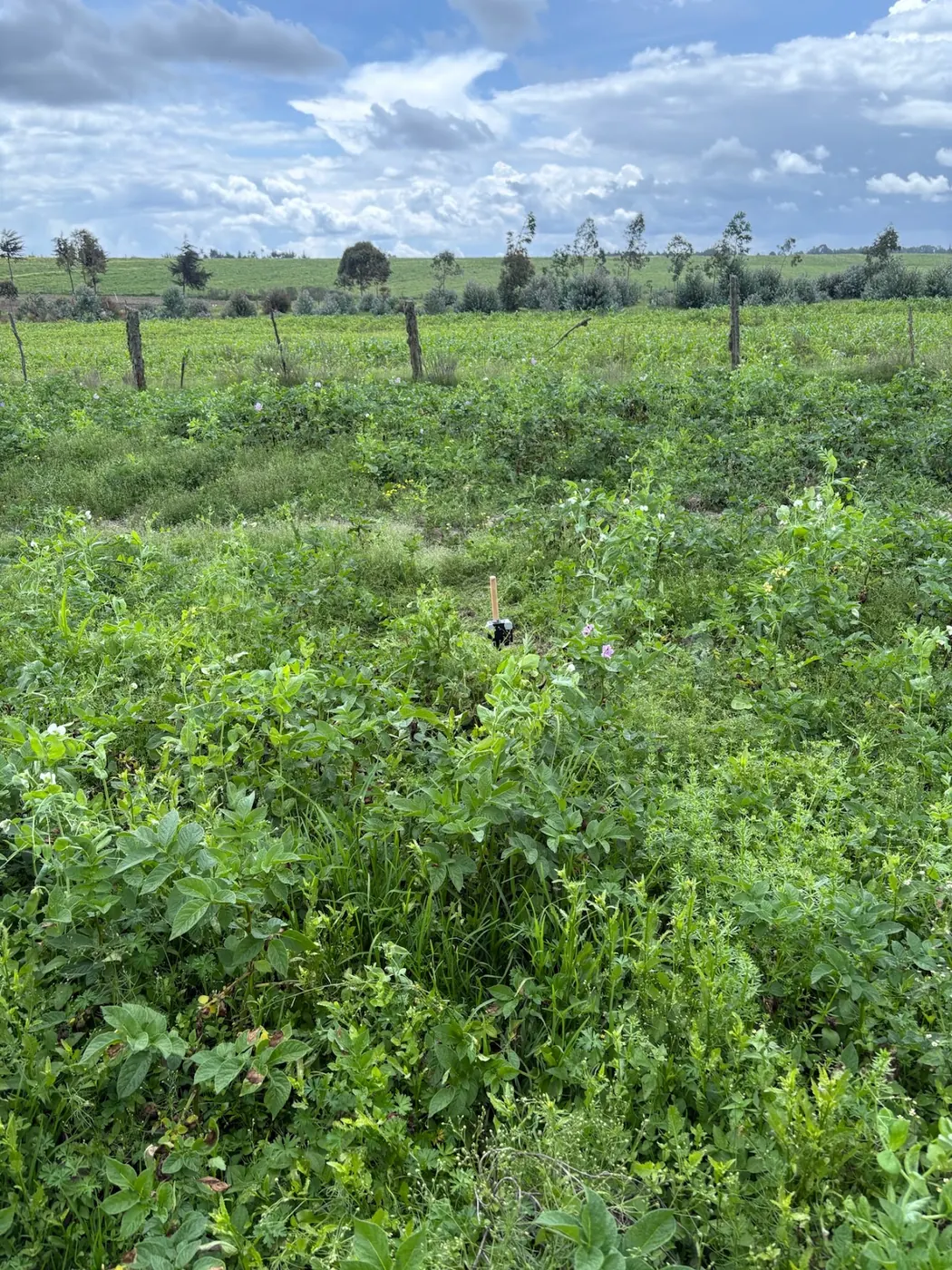
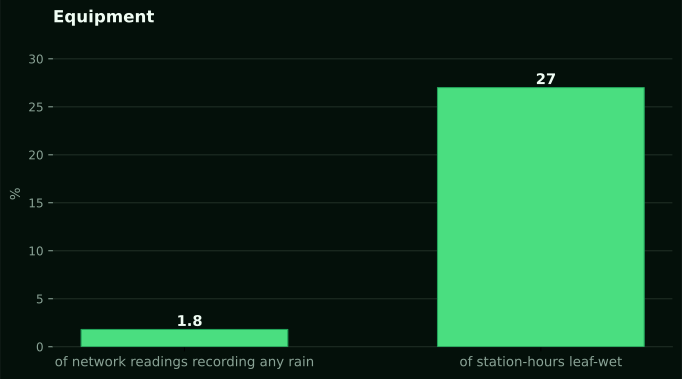
To make the case concrete: across seven NuaSense stations over 21 August to 20 September 2026, air temperature ranged from 3.7 to 36.1 degrees Celsius, with a mean of 18.3 degrees Celsius. Relative humidity averaged 72 percent, ranging from 21 to 100 percent. Only 1.8 percent of ten-minute readings across the network recorded any rain at all. Yet rainfall totals for the period, measured across four stations, ranged from 0.4 mm to 104.4 mm. That spread is between stations that are not co-located and should not be averaged into one regional figure. Compare that against the long-run September average at those same station locations. It is 35 mm across 43 years of the CHIRPS satellite rainfall record, with a driest September of 5 mm in 1997 and a wettest of 79 mm in 2020. A single season's own-station reading can sit well outside that historical range in either direction. That is exactly why a station on your own field, not a regional average and not last year's memory, is the input that matters for this season's decisions.
Leaf wetness duration, one of the derived values a connected station computes, averaged 27 percent of station-hours across the same network and period, about 6.4 hours in an average day. That single number sits underneath most spray-timing decisions, and it does not exist at all without a station carrying humidity, temperature and rainfall together over time. A rain gauge cannot produce it. Neither can a memory of what the season usually does.
Laying the tiers side by side
The table below is a summary of what each tier actually includes, not a price list. None of the sources here publish a market price for a station.
- Manual rain gauge: rainfall total only, read and logged by hand daily. No power, no calibration schedule, weekly funnel check for insects and debris.
- Basic station (unconnected): adds wind speed, air temperature, humidity, air pressure, sunlight. Needs siting to clearance rules and periodic sensor checks; humidity accuracy degrades above 90% RH on medium-cost sensors.
- Full sensor set for ET0 and spray scheduling: solar radiation, wind speed, relative humidity, air temperature together, feeding the FAO-56 method. This is the tier a NuaSense station (KES 30,000, excluding taxes) sits in, reporting roughly every 10 minutes and computing ET0, dew point, VPD, leaf wetness and spray window score.
- Add soil monitoring: a soil sensor at KES 7,000 (or KES 9,000 / KES 10,000 for extra channels, excluding taxes) connects through the same station, no separate gateway, reading shallow and deep moisture and temperature roughly every 10 minutes.
- Connectivity and access: SIM data at roughly one US dollar per station per month (free on Wi-Fi), free dashboard with five downloads a day, API at one US dollar per 1,000 calls, alerts at 0.03 US dollars per message.
Who should not buy the connected tier
If the only question a farm manager has is whether it rained and roughly how much, a manual gauge answers it completely and for almost no cost. Provided someone actually reads it every day. Buying a connected station to answer that single question is spending on capability nobody will use. The connected tier earns its cost when the decision on the table is timing: when to irrigate against actual crop water demand, when a spray window is open rather than wasted on wet leaves, or when soil moisture at depth, not at the surface, tells a different story than the topsoil does. NuaSense stations and soil sensors are built for that second kind of farm. They are the wrong purchase for the first. This site's earlier look at IoT applications already in use on Kenyan smallholder farms covers the lower end of that spectrum. That lower end includes low-cost sensor options that suit a smaller operation better than a full weather station does.
The honest gap in all of this is that no source here gives a market price for any tier of station sold in Kenya. The only market price is for the one product line this article is allowed to quote. A buyer comparing brands has to build their own comparison from vendor quotes. The published research is useful on sensor accuracy, siting rules and what each parameter buys. But it was never written to price a purchase.
The decision, restated as a question
The real question is not what a station costs in the abstract but what decision it needs to support. A rain total decision needs a gauge and a habit of reading it. An irrigation or spray timing decision needs the fuller sensor set, and increasingly a soil probe alongside it, because air readings alone cannot say what roots are experiencing below the surface. A farm that has never had either should probably start with the gauge and a season of honest daily readings before spending on anything more, simply to learn what questions the farm actually asks of its own weather. The stations described here, ours included, are built for the farm that has already asked that question and found the gauge was not enough.