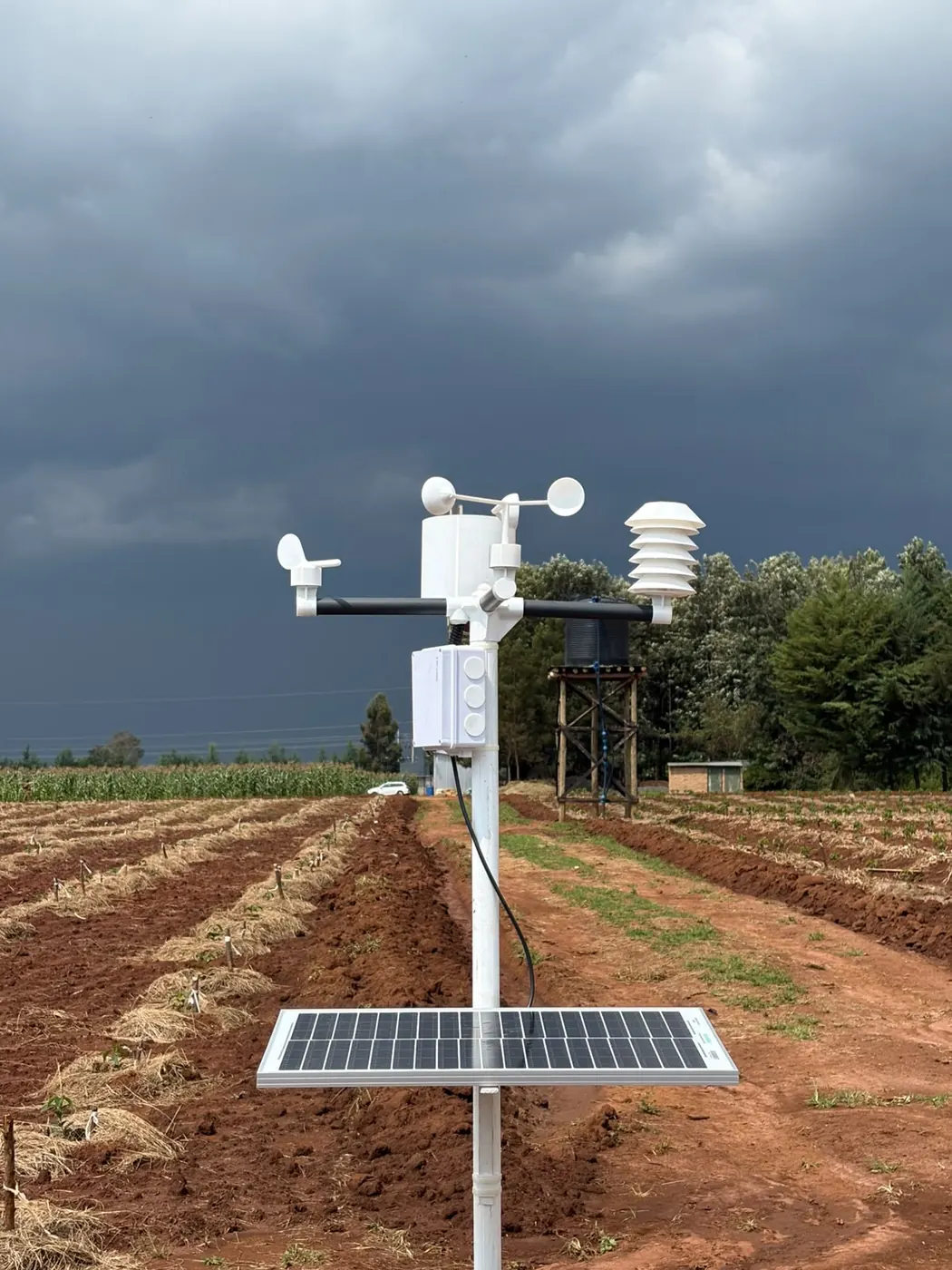
A weather station should sit where the crop is, not where power lines already run. On most Kenyan farms that means a pole in the middle of a block, often far from the nearest transformer. Cable to that distance costs more than the station itself. So the station must make its own power and find its own way online. A solar weather station is the usual answer for the power side. If you shop for power alone and forget the data link, you end up with a mast measuring rain nobody can see.
Measured by NuaSense weather stations and soil probes on Kenyan farms, over the period stated with each figure. Past readings, not a forecast.
Two problems, not one
Power is the first problem: the panel needs enough sun, and the battery needs enough charge to run sensors at night and through a cloudy spell. The data link is the second: how the reading gets from the mast to a phone or dashboard. It is easy to think solar fixes both, since the panel and SIM card sit on the same pole and the seller quotes them in one sentence. They do not solve the same problem. A station can have a well-sized panel and still be useless if the SIM card sits in a dead patch of Safaricom coverage. A station on strong signal can still go dark for a week if the panel was undersized or the glass was never cleaned.
The University of Florida's guide to installing and maintaining a farm weather station puts the power side in one sentence: a solar panel runs the station during the day and charges a battery for the night. That is the whole mechanism. No diesel generator stands by, no inverter, no mains fallback. What decides whether it holds up is not a wattage on a spec sheet but three things a buyer can check before paying: how much direct sun the site gets across the year, how dusty or shaded the mounting spot is, and who will clean the glass. This piece is written for the person still choosing, not the person who has already decided to buy, and some of what follows argues against buying anything at all.
Solar sizing for Kenyan sun, and where the real data on this comes from
Nobody has published a solar-radiation dataset for a Kenyan weather station site, so this section has to borrow and say so plainly. The World Bank's solar radiation measurement campaign in Burkina Faso ran ground stations at Kaya, Koupela, Dedougou and Dori between 2021 and 2023. That was part of a West African Power Pool effort to measure solar resource on the ground rather than assume it from a continental irradiance map. It is a Sahelian dataset, not an East African one, and none of its figures transfer as a number. What transfers is the method: someone put instruments on the ground and measured, rather than trusting an average that smooths over cloud, dust and season.
A Kenyan buyer should do the same thing at the scale of one farm. A station under the shade of a mature tree, or downwind of dust off a murram access road, sees less usable sun than the same panel thirty metres away in the open. Arizona's siting guidance for growers makes exactly this point about shade cutting the solar radiation a station measures, which applies just as much to the radiation its own panel depends on. The practical test costs nothing: watch where the shadow of the nearest tree or building falls at 9am and 3pm across a few weeks before the pole goes in, not after.
None of the sources here give a wattage, an amp-hour rating or an autonomy figure in days without sun, and this piece will not invent one. What you can ask a supplier honestly is what happens on the fourth consecutive overcast day, and whether the answer is measured or assumed.
Getting through a cloudy week is a maintenance habit, not a spec
The single biggest lever on a solar station's reliability is not the panel's size, it is whether anyone wipes it. NEWA's maintenance guide for weather stations tells operators to clean the panel with an alcohol wipe or a soft damp cloth, especially after spraying near the station, because chemical film cuts light through the glass just as effectively as dust. The Florida guide gives the same instruction in gentler language: warm, mildly soapy water, a clean cloth, then a rinse. Neither source gives a schedule tighter than routine, which tells you this is upkeep, not a warranty claim waiting to happen.
Two more items from the same guidance belong on the same checklist because they fail the same way: quietly, without an alarm. NEWA notes that a station knocked out of true during mounting or a storm can jostle the tipping-bucket arm and log rain on a dry day. Wasps sometimes nest inside the bucket, and a scrap of insecticide strip works as a deterrent. Neither failure looks dramatic on a dashboard. The station keeps reporting numbers, just wrong ones, which is worse than none, because a farmer who trusts a silent instrument acts on a false spray window or skips an irrigation the crop needed.
Every maintenance guide cited here says the same thing. On an off-grid station, labour is what drives the running cost, not electricity. Someone has to walk out to the mast every few weeks, wipe down the panel, check the wind vane still points to true north (NEWA flags rechecking this after any bump), and look for nests. Buy a station, bolt it to a pole, forget it: that is how this hardware disappoints most often, and solar sizing has nothing to do with it.
The data link: LoRaWAN gets sensors to the mast, the mast still needs a way out
Here is where buyers mix up two different radios. A soil moisture probe out in the field needs no SIM of its own and no panel of its own. It talks to the weather station over LoRaWAN, a low-power, short-range link made for exactly this job. The station on the mast then carries those readings, and its own, out to the internet. LoRaWAN covers a field. It does not cover a county. There is no separate gateway box to buy, because the weather station on the mast is the gateway, and one station puts a farm's soil sensors online rather than one station per sensor.
The link that gets you off the farm entirely is a different one. It runs over a Safaricom SIM card, or over WiFi where the site has it. Coverage decides whether this link works, so test it before you order hardware, not after. Get a weak signal or none at all at the mast site and a solar-powered station with a perfect panel and spotless glass still reports nothing, because the readings have nowhere to go. Some sites fix this by mounting a little higher or shifting toward higher ground. Others simply have no workable coverage, and buying the hardware anyway is the mistake.
A NuaSense weather station works on either link. It gets itself to the internet over a Safaricom SIM, or over WiFi where that is available. The SIM data fee is passed on at cost with no markup, roughly a dollar a station a month, and WiFi carries no data fee. Know that running cost before you buy; it sits apart from the KES 30,000 the station itself costs, excluding tax. A soil sensor add-on runs KES 7,000 to KES 10,000 depending on channels. None of it is worth paying for on a site where the mast cannot get a signal out.
What one solar mobile station in Sri Lanka actually demonstrates
The best evidence for a mains-free station comes from outside Kenya, and the transfer has to be made openly. IWMI's mobile weather stations were built for flood monitoring with funding through the World Bank and CGIAR research programmes. They run on solar, operate autonomously, transmit rainfall, temperature and wind speed every five minutes, and are assembled locally from off-the-shelf parts, Arduino boards among them. IWMI gives the unit cost as $350, a working life of up to ten years, and a payback of about two and a half years measured against flood damage avoided. None of it sat on a Kenyan farm. It was built for flood-prone catchments IWMI works in, and the payback math hangs on flood damage, not crop yield.
Related reading on this site: weather stations, What a farm weather station costs in Kenya.
What does carry over is the design logic. A five-minute reporting interval matters when the decision on the other end is fast, a flood warning for instance. Whether it matters for a decision made once a week, such as irrigating a block this weekend, is a separate question each buyer has to answer for their own operation. Paying for a ten-minute reporting interval, which is what a NuaSense station reports at, means you should ask which of your own decisions needs that cadence. The answer decides what tier of hardware is worth your money.
The other half of IWMI's design is a useful fallback for a site with unreliable connectivity: data stored on a microSD card, alerts pushed out by SMS. The instrument keeps recording locally even when nothing goes out over the air, and someone can walk to the card and pull the record later. NuaSense is not built that way, since its value depends on readings reaching a dashboard automatically. Still, it is worth knowing the fallback exists in principle for a site expecting long connectivity outages.
A cheaper alternative: SMS forecasts instead of on-farm sensing
Not every farm needs a mast, and an honest comparison has to include skipping hardware altogether. PlantVillage's iShamba service reaches over 500,000 users in Kenya on feature phones. It uses CHIRPS satellite rainfall data at 5 km resolution to send historical, current-season and ten-day rainfall figures by SMS, geolocated to within 5 to 9 km from the farmer's ward and nearest school rather than GPS. In the 2022 long rains it sent 8.8 million messages, at a running cost of $1,800 per 350,000 messages. Of the farmers surveyed who said the service helped them, about half said it helped them plant on time.
This product is not the same thing as a weather station, and that gap changes how you buy. A 5 km satellite grid cell gives a farmer a rough idea of rain over several farms. It cannot tell them if their own canopy is wet at 9am. That comes down to their microclimate and their morning. An earlier piece on this site took apart this spread on our own network. Over the same month, rainfall totals between stations ran from 0.4 mm to 65.7 mm. That gap is wide enough that using a neighbour's figure, or a satellite grid cell's figure, can send a spray or irrigation call badly wrong. SMS forecasting fits a farmer who wants a seasonal feel for the rains and cannot justify hardware. For someone deciding whether to spray this afternoon, it is the wrong tool.
Simulated grids against measured points, and why that distinction decides the buy
Japan faced this same tension, and its experience points to the two data products a Kenyan buyer is choosing between. The national automatic weather network, AMeDAS, measures temperature, wind and sunshine at 840 fixed points nationwide. But a Japanese research team's paper on the KOSEN weather station, installed in Yamagata and running stably for over nineteen months across a range from minus 16.5 to 44.9 degrees Celsius, says AMeDAS points are too sparse to describe conditions on any one field. The national agriculture research organisation's alternative, a 1 km² gridded dataset, fills those gaps. The paper is clear, though: this grid is simulated, not measured. It is model output, not an instrument reading.
A Kenyan buyer faces the same choice, only the products carry different names. A national meteorological network gives representative points. They are sparse and free. A satellite grid such as CHIRPS, which sits under the iShamba SMS service, gives a modelled surface. It is dense and cheap. Only an instrument standing in the field, whether a KOSEN-style station or a NuaSense one, gives a measured reading of that exact block. The KOSEN team built their station to alert a farmer when the current temperature crossed a set threshold, high or low. For someone who will not check a webpage every morning, that is the minimum useful output of an off-grid station. It never forecasts anything. Neither should any station a Kenyan grower buys. An instrument reports what already happened, not what is coming.
Comparing the options side by side
Put side by side, the choice stops looking like one purchase. It looks like four different products solving four different problems, at four price points and four reporting rhythms.
- National met network or public satellite grid (CHIRPS/SMS via iShamba): free to the farmer, reports at daily to ten-day intervals, geolocated to 5 to 9 km, no equipment to buy or maintain, best for seasonal planning, wrong for same-day spray or irrigation calls.
- Solar mobile station on the IWMI model: around $350 in the flood-monitoring project it was built for, reports every five minutes, stores data on a microSD card with SMS fallback, not sold as a commercial product a Kenyan farmer can currently order.
- A NuaSense weather station: KES 30,000 excluding tax, reports roughly every ten minutes over Safaricom SIM (about a dollar a month, at cost) or WiFi (no data fee), dashboard included free with five downloads a day, API access at a dollar per 1,000 calls, SMS or WhatsApp alerts at two US cents a message, solar powered with no mains connection needed.
- Soil sensors added to the same station: KES 7,000 to KES 10,000 depending on channels, connecting over LoRaWAN to the station already on the mast, no separate gateway to buy.
The comparison only stands if the connectivity link works at the site. If a farm has no usable Safaricom signal and no WiFi, a station bought for it is a bad purchase, whatever the tier. No amount of solar sizing will fix that.
Accuracy tiers, and what feeds a real decision versus a rough one
Not every reading needs the same precision. This is where a buyer can overspend or underspend. The Florida extension guide notes that mid-cost weather station sensors usually hold relative humidity accuracy to about plus or minus 3 percent below 90 percent RH. Above that threshold, it widens to 4 to 5 percent. Air temperature stays at about plus or minus 1 degree Fahrenheit across the full range. Those figures describe a class of instrument generally. This piece will not attach a tolerance figure to NuaSense hardware, because none is published for it.
Practically, humidity accuracy drops off exactly where disease risk lives. Above 90 percent RH is the range that drives leaf wetness duration and spray window scoring. A station whose humidity sensor loses precision there gives its weakest number when a farmer most needs a strong one. A companion piece on this site explains why leaf wetness duration, not rainfall total, predicts infection risk for many diseases. A station feeding that calculation is only as good as its humidity sensor's behaviour in exactly that range. For a farmer scheduling irrigation from rainfall totals and soil moisture alone, that precision matters less. A simpler tier is a reasonable choice.
Who should not buy any of this
A station, solar or not, is the wrong buy for a farm smaller than the area one reading can usefully describe. It is also wrong for an operation that already sprays and irrigates on a fixed weekly schedule, regardless of weather. And it is wrong for a site where the connectivity test comes back weak. A station that cannot phone home is an expensive rain gauge nobody reads until someone drives out to look. In those cases, the free national grid and the SMS services built on it deliver more value per shilling than hardware that sits unread. Their 5 to 9 km resolution is imperfect, but it still beats unread hardware.
Take a mixed farm that makes its own spray and irrigation calls. If the block is big enough that a neighbour's gauge or a satellite cell gets it wrong, measuring on the farm has a real case. The solar-and-SIM setup described here is the practical way to run that without a mains connection. What it needs is a panel someone will actually wipe, a signal someone actually tested before the pole went in, and a decision at the other end that is worth the reporting interval it pays for. Miss any one and the hardware, however well sized for the Kenyan sun, will not tell you anything you can act on.
Before you sign anything
This short checklist earns its place because every item can be checked before money changes hands. Test the Safaricom signal at the exact mast location, not from the farmhouse. Watch the site for shade over a few weeks, at the times of day when the panel works hardest. Ask who is assigned to wipe the glass and check the mounting. That answer predicts uptime better than any spec sheet. Ask what decision the ten-minute readings are meant to feed. A fast reporting interval bought for a weekly decision is money spent on a cadence nobody uses. NuaSense's overview of smart irrigation options in Kenya covers where a weather station sits alongside drip systems and soil sensors in a wider water strategy, and it is worth reading before deciding a mast is the first hardware a farm needs.
Also drawn on for this piece: A Grower's Guide on Selection and Use of Weather Stations.