Measured by NuaSense weather stations and soil probes on Kenyan farms, over the period stated with each figure. Past readings, not a forecast.
Three instruments, one decision
A grower asking about rain gauge price in Kenya has three things in front of them at the agrovet or on a phone screen: a clear plastic tube with graduations moulded on the side, a metal standard gauge with a funnel, a brass rim and a separate measuring cylinder, and a connected tipping-bucket gauge that sits on a weather station and sends its count over the air. None of the sources behind this piece carries a shilling figure for the first two, and this article will not invent one. What it can do is say what each instrument delivers, what each costs in labour and attention, and where money gets wasted.
- Plastic tube | pays for: the tube and a post | gives: a daily millimetre if someone reads it | right for: one block, one reader, a notebook
- Metal standard gauge | pays for: rim, funnel, cylinder, a concrete base | gives: a reading comparable with formal networks | right for: a site matching a county or project record
- Connected tipping bucket | pays for: the mechanism, the station it sits on, the data link | gives: a ten-minute record nobody walks to | right for: a manager with several blocks, or a reading that feeds a decision elsewhere
The line held throughout: for most single blocks the cheap tube is the right buy, a site that must match a formal record needs the metal gauge, and the connected gauge is for the grower who is paying to stop walking to the post every morning. That ranking is by job, never by accuracy, and the drift section explains why the expensive one does not win that contest.
All three measure a depth
One point cuts through a lot of marketing noise. The FAO annex on rainfall measurement defines rainfall as the depth of water that would cover a horizontal area if there were no runoff, infiltration or evaporation, given in millimetres. A plastic tube, a brass gauge and a tipping bucket all report that same depth. An expensive instrument does not report a better kind of millimetre. It reports the same millimetre, more often, with nobody standing there, and with its own set of faults.
What the FAO specification cares about is geometry, not technology: a receiving area of 200 to 500 cm2, a rim with a sharp edge falling away vertically inside, and a funnel slope steeper than 45 degrees so drops cannot splash back out. A plastic tube built to those shapes measures correctly. A tipping bucket that misses them measures badly, however clever its radio.
Resolution differs, and you want to know that before you pay. FAO asks for a clear glass or plastic cylinder with graduations engraved in 0.2 mm steps, readings recorded in units of 0.1 mm, and anything under 0.05 mm written as a trace. A tipping bucket counts in whole tips. The Cornell NEWA note on rain gauge accuracy describes a Rainwise bucket whose reed switch registers one tip per 0.01 inch, which is 0.25 mm. So read by a careful person, a manual cylinder resolves finer than that bucket. The connected premium buys you frequency and absence, never a sharper number.
The plastic tube: what the cheap one gets right
Most Kenyan growers should start here, and the evidence is kinder to the tube than its price suggests. Cornell says plainly that plastic manual gauges with a 4 inch opening are quite accurate. The US NOAA observer network runs 8 inch manual gauges, described as the most accurate option and the more expensive one. But look at what sits at the top of that ranking: a manual gauge, not an electronic one. Between a 4 inch plastic tube and the best gauge in the trade, the gap is rim diameter and build, not the technology inside.
What the tube does not give you is a reading without a reader. Cornell puts it bluntly: a manual gauge is as accurate as the person checking it, recording the figure, emptying it and resetting it. On a Kenyan block that usually means a farm hand or the owner, and the record is only as good as the morning that was skipped. That is the real cost of the cheap gauge. Purchase small, labour daily and permanent.
Plastic ages as well. FAO lists non-corrosive metal, fibreglass and plastic as the normal materials, and plastic earns its place because it does not rust, but under strong sun a tube clouds and the graduations fade. Cornell recommends cleaning any gauge at least once or twice a year, and some sites every three months, because leaves, moss, algae, pollen and debris collect in the funnel. A tube under a windbreak of gum trees is a three-month site. Budget for a replacement rather than nursing a cloudy one. A figure you cannot read is worse than no gauge.
So the cheap gauge earns its place when one dependable reader handles a block. The figure feeds a notebook, not a contract, and the decision it carries might be whether to re-sow a patch. For that job, anything dearer buys features the decision never uses.
A metal standard gauge buys comparability, and sometimes a contract
Growers spot a metal gauge at a county station or an old estate and figure it must be the better tool. It is better at one job: making records comparable. FAO insists that gauge type and installation method match other gauges in the area so the data can be compared. Where the siting differs from local practice, FAO suggests running the two gauges side by side. If a farm's record will sit beside a Kenya Meteorological Department station record, or inside a project like the Kwale one below, a metal gauge of the same pattern takes out the question of whether the instrument caused the difference.
The money goes into the specification, not the brochure. A sharp vertical rim. A funnel steeper than 45 degrees. A separate cylinder no wider than one third of the rim; that is what makes the 0.2 mm graduation readable. Then the mounting. FAO wants the gauge firmly fixed on a concrete base, with the rim always horizontal, on level ground that is preferably grassed or loose earth. Concrete and levelling are part of the price. Wire a metal gauge to a loose fence post and that money is gone.
Its best case comes when a farm is one point in a wider network. The Gro for GooD rainfall dataset held by the British Geological Survey shows exactly that use in Kenya: twenty-three manual gauges across the Ramisi, Mukurumudzi, Mtawa and Mwachema catchments in Kwale County. They were read daily from January 2016 to November 2018. Nothing tipped and nothing transmitted, and the result was archived nationally.
There is a second case, and accuracy has nothing to do with it. The World Bank case study of the Indian rainfall index insurance market describes policies that pay out based on rainfall recorded at a particular gauge during phases of the monsoon. Once a contract names a gauge, that gauge becomes a financial instrument. Whose gauge is it, how is it sited, who reads it, and can the reading be reproduced in a dispute? That is an Indian market, and no Kenyan product is cited here, so what transfers is the logic. If a Kenyan grower or group ever expects a rainfall reading to settle a claim, a loan covenant or a scheme payment, hold it to the FAO standard on a concrete base. A faded tube read at odd hours will not survive an argument.
A tipping bucket buys you out of the morning walk
Judge the connected gauge by the labour it takes off the farm, not by the tube it replaces. FAO's observation routine is specific, and it is unforgiving. Read once a day at the same hour. Record in 0.1 mm. Write a trace below 0.05 mm. A 24-hour catch observed at or before 09.00 goes to the previous day. So a reading taken at 08.00 on the first of December is entered under the thirtieth of November. That last rule quietly breaks most farm rainfall notebooks. Whoever reads the gauge writes the figure against the day they read it, and the record ends up a day out against every official series it is later compared with.
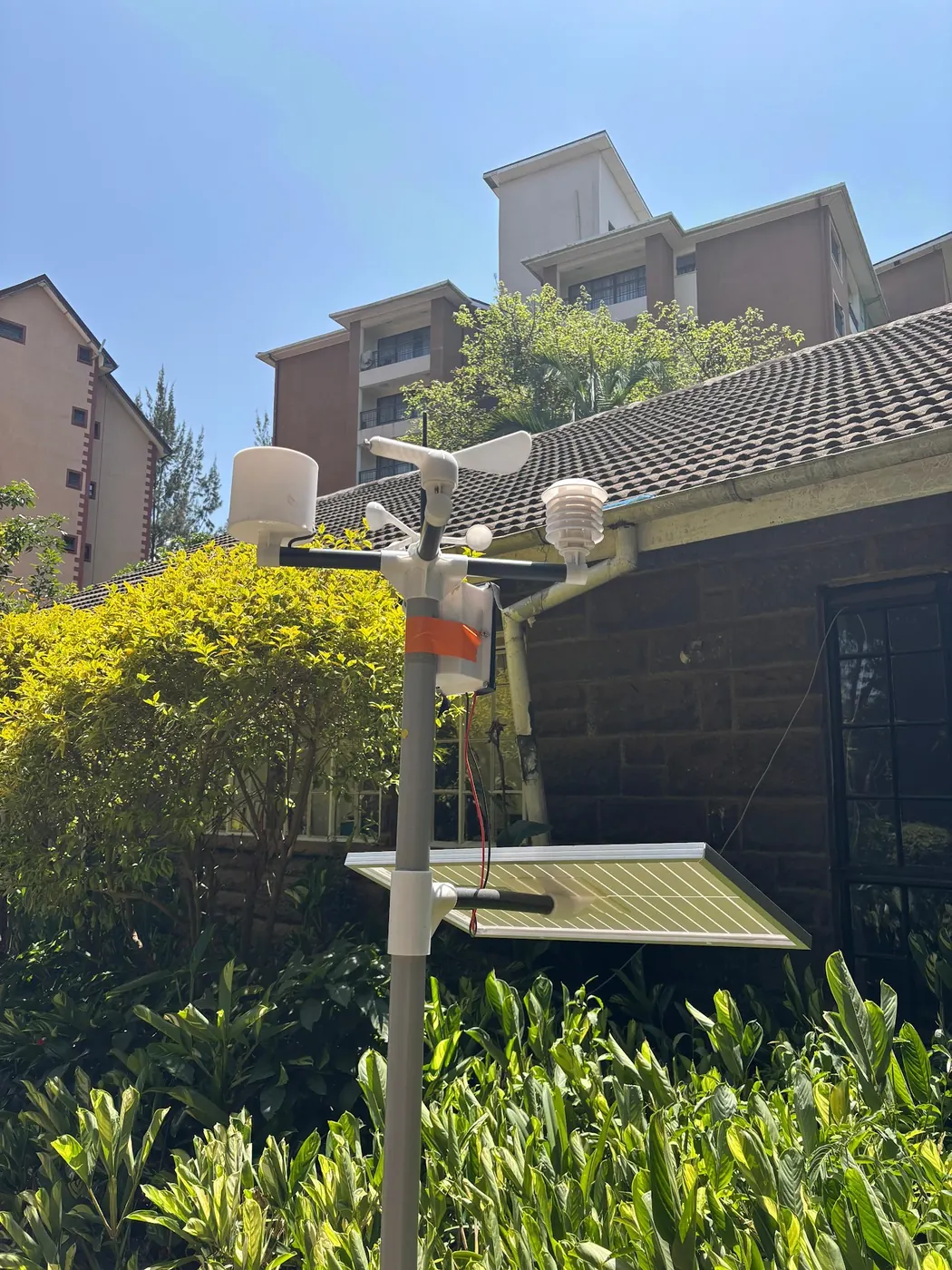
A tipping bucket takes all of that out of the routine. It counts tips and stamps each one with a time, so the convention becomes a setting, not a habit. Our own station reports rainfall about every ten minutes, along with temperature, humidity, pressure, sunlight and wind. A manager with several blocks can see this morning's rain from a phone before the vehicle leaves the yard. That is what you are buying: continuity without a person, and a timestamp fine enough to show whether rain fell before or after a spray went on. Our rain gauge page lists what the gauge on the station reports.
The bucket comes with two limits. Cornell notes that tipping gauges under-catch in very heavy rain, above 1.5 inches in an hour, because the arm cannot keep up. It also notes that the shortfall tends to disappear against manual gauges over longer periods. Long-rains storms in Kenya can be intense, and the per-tip volume the gauge is calibrated to sets how fast it can count. The second limit gets its own section: the bucket's accuracy has a lifetime.
Drift is the strongest argument for the cheap gauge
If you are choosing between a tube and a connected gauge, start with this figure. Cornell rates the Rainwise tipping bucket at 2% accuracy at a rainfall rate of 1.5 inches per hour. That is the factory number. The same note says automated gauges are calibrated by the manufacturer, but after two or three years in service they can drift, and that drift brings errors of 5%, possibly as high as 10%. A dearer instrument does not hold its rating. It leaves the factory at 2% and, left alone, arrives at 10%.
A plastic tube has no reed switch to age and no pivot to gum up. Its error is the reader's, and you can retrain a reader in a morning. A connected gauge's error is mechanical, slow, and invisible on the dashboard, because a bucket under-counting by a tenth still produces a tidy time series. That is why two or three years, not the purchase date, is the right planning unit for a tipping bucket. Ask whoever sells you one what recalibration involves and who does it. Get no clear answer, and you should assume the job falls to you.
Cornell spells out the practical check: if the bucket collects less than 90% of what a manual gauge at the same site collects, a clog is likely. Read those two findings together and the case for a connected gauge on a Kenyan farm becomes a case for keeping a plastic tube beside it. It costs little, it does not drift, and it is the only instrument on the farm that can tell you the bucket has started lying. Buy the connected gauge and throw the tube away, and you have removed the one control that justified the spend.
Why does a mechanism rated at 2% fall so far? Because dirt and wear move it, not electronics. A funnel half-blocked with pollen passes water slowly enough that the arm tips late; a pivot stiffened by grit tips short. Neither shows as a gap in the record. Both show as slightly less rain than fell, week after week, which is exactly the pattern a grower reads as a dry month rather than a dirty gauge. Put it beside a tube and the shortfall is obvious in one storm.
We publish no accuracy or tolerance figure for our own rainfall sensor, and this section is not a claim about it. It describes how tipping mechanisms behave over time, drawn from a network that runs many of them. The control-gauge habit applies to ours as much as to anyone's.
Faults that look like rain
A manual gauge fails by silence: nobody read it. A connected gauge fails by producing numbers, and that is a dearer kind of failure because numbers get acted on. Cornell lists three ways a connected gauge stops collecting altogether: a clogged funnel, a loose cotter pin on the screen obstructing the arm, and a faulty reed switch in an instrument over three years old. At least those show as a flat line during a storm, which a grower looking at the sky will notice.
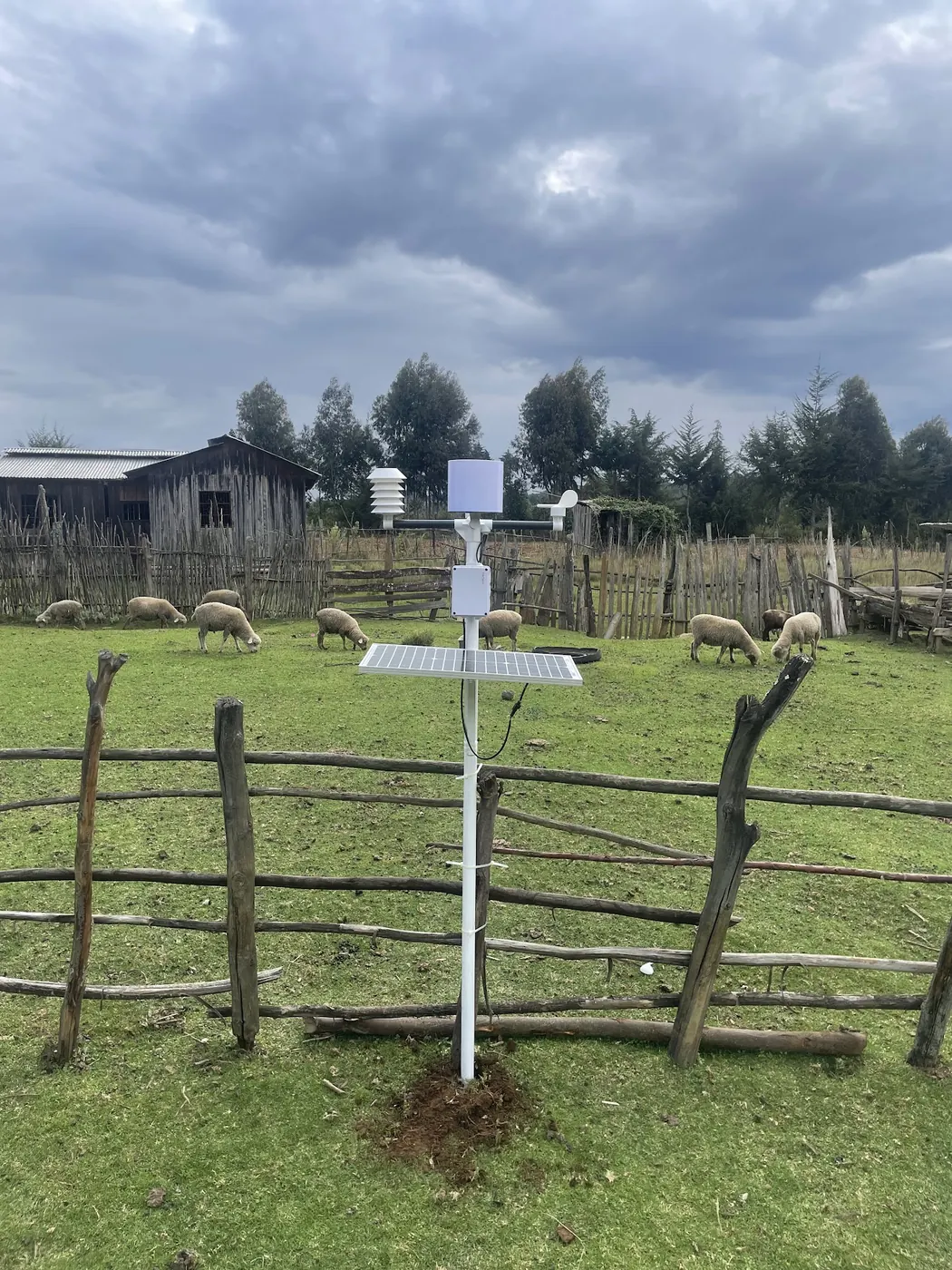
The subtler faults are the ones to learn. Random trickling readings of 0.01 to 0.02 inches, logged every hour or two across a dry day, are not light drizzle. Cornell traces them to a clogged bucket slowly draining, a station mounted so poorly it sways in wind, or a failing reed switch. A mast strapped to a fence post in an open Kenyan field will sway, and each sway can tip the bucket. Over a season those phantom tips are small enough to pass unquestioned and large enough to distort a water balance or trigger a leaf wetness flag.
Then there is the dramatic version: a false total like 5 inches on a day that barely drizzled. Cornell puts it down to a shorted reed switch or cross-communication from another station, with reports of 1 mile range stations picking up a station 2 miles away. On an estate running several consumer-grade kits, or near a neighbour with the same brand, that is a real risk. None of this argues against the connected gauge. It argues that its price includes a habit: compare the trace to the tube on a known dry day and in a known storm. The post on rain gauge errors, undercatch and spacing sets out that side-by-side check and the fixes that follow.
The site costs more than the instrument
If there is one number to carry away from this piece, make it this. FAO says wind, gauge height and exposure are the main things that affect how accurate a rainfall reading is, and that wind and exposure errors can be very large, more than 50 percent. Put that next to the instrument figures above: a 2% bucket that drifts to 10%, a plastic tube Cornell calls quite accurate. The gap between a badly sited gauge and a well sited one is several times bigger than the gap between the cheapest and dearest instrument on sale. Fix the site first. Money spent on a better gauge before that goes to the smaller problem.
Siting rules are short, and they cost nothing but thought. FAO puts normal exposure height at 30 cm above ground. Wind degrades the catch higher up, and FAO notes that the more open the location, the greater the difference in catch with height. No building, tree or other instrument should be closer than four times its own height. A tree 10 m tall needs the gauge 40 m away, and each obstacle gets the same sum. Avoid hilltops and other very exposed sites. Ground should be level, grassed or loose earth, and the rim horizontal.
Now the Kenyan complication, and the honest limit. Those rules were written for formal observing stations with space to spare. On a smallholding with a house, a store and a line of trees on the boundary, the four-times-height rule often cannot be met anywhere on the plot. A one-acre block with a mature grevillea hedge may have no compliant site at all. Then the choice is between the least bad spot and no gauge. The least bad spot still beats the phone, as the earlier post on why phone rainfall and field gauges disagree worked through for Kenyan conditions.
One more trade-off, said plainly. That 30 cm height is for a manual gauge read by a person. A connected gauge on a station mast sits higher, because the wind and temperature sensors need the height and the solar panel needs the sun. Rain catch pays for that compromise. A grower who wants the best rainfall figure on a station site keeps the tube at 30 cm in the open and uses it to check the mast. Buying the dearest gauge and mounting it under a tree because the cable reached there is the most common way to waste the money. No instrument on sale fixes it.
One gauge for a neighbourhood
Nobody asks at the counter whether the farm needs its own gauge at all. The evidence here is Indian, measured around Bangalore, and it transfers to Kenya with care. A study of rain gauge density published through PubMed Central looked at a 50 km by 50 km box. For short-lived intense rain, the correlation between gauge estimates fell from 82% to 21%, and root mean square error rose from 8.29 mm to 51.27 mm, as spacing widened from 5 km to 40 km. Across all events the fall was from 92% to 37%. Three stations within 2 to 5 km of each other showed significant hourly differences during one two-day storm in September 2009. Their summary rule is the useful part: within 15 km rainfall variability is not abrupt; beyond 15 km it is high. Taking 8 gauges as the standard for a region, absolute error rose from 15% with 7 gauges to 64% with 1.
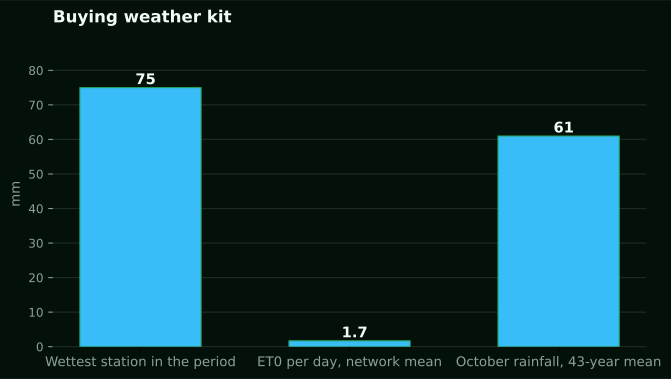
Transfer that carefully. Bangalore's rain is convective and short-lived, the regime most likely to vary over short distances. Kenyan afternoon storms in the highlands and the lake basin share that character, so the direction probably carries even if the figure does not. Our own network shows the same shape: across 10 NuaSense weather stations in Kenya, station totals over 18 September to 18 October 2026 ranged from 0.0 mm to 75.3 mm. That is a spread between stations that are not co-located, not a regional figure. It says one thing clearly: no station can speak for a farm some distance away.
So the scale argument runs both ways. A single small plot does not need its own gauge if a trusted neighbour, cooperative or county station within a few kilometres keeps a good record and shares it. An estate spread across more than one valley needs several, because one reading cannot represent its blocks. Fifteen kilometres is a Bangalore number, not a Kenyan rule. Its right use is to make a grower ask how far the nearest good gauge actually is. Records are gaining value as the pattern shifts: the Kenya Meteorological Department's State of the Climate report for 2025 reports large regional differences and uneven distribution in 2025 rainfall. It also reports growing variability that complicates planning for agriculture and water. What that variability has already done to maize, tea and coffee is covered in the NuaSense post on climate change and crop yields in Kenya.
Where our station sits, and who should buy the tube instead
This piece is named after a price, so here is ours. A NuaSense weather station costs KES 30,000 excluding taxes. Its rain gauge is a tipping bucket that counts tips and converts them to millimetres at the per-tip volume the gauge is calibrated to. It also reports air temperature, humidity, air pressure, sunlight, wind speed, gusts and direction roughly every ten minutes. From those readings it computes reference evapotranspiration, dew point, vapour pressure deficit, leaf wetness duration and a spray window score. It is solar powered, reaches the internet on its own over a Safaricom SIM or the farm's Wi-Fi, and the SIM data fee is passed on at cost, typically about one US dollar per station per month, with no fee on Wi-Fi. Dashboard included. Payment falls due a month after the station is transmitting, with a full refund available in the first three months. A soil sensor linking to it over LoRaWAN costs KES 7,000, and our weather station page lists everything it records.
Who should skip it: the grower with one block, one reliable reader, and a decision that hinges on a daily total. For that grower, buy the tube. Site it at 30 cm in the most open spot the plot allows. Read it before nine each morning and write the figure against the previous day's. A station gives that grower nothing the tube does not. The same goes for a smallholder within a few kilometres of a neighbour or cooperative that keeps a good record. The spacing evidence says the shared gauge serves them, and the money is better spent elsewhere.
Who should buy one: a manager running blocks that cannot be walked each morning, anyone whose rainfall figure feeds a spray decision that depends on the hour rather than the day, and anyone who wants rain sitting beside wind, humidity and leaf wetness rather than alone in a notebook. A station is a rain gauge with a great deal else attached. That is the only honest way to price it. Even then, keep a plastic tube on a post beside the mast. It is the control. It does not drift. After two or three years, it is the instrument that tells you whether the bucket still deserves its place.